
Best Courses to Study in UK
Table of Contents
- Top Undergraduate Courses to Study in UK
- Top Masters Courses to Study in UK
- Top UK Universities for Popular Courses
- Eligibility Requirements for Studying Popular Courses in UK
- Cost of Studying Different Courses in UK
- Career Opportunities After Studying in UK
- How to Choose the Right Course in UK
- Conclusion
UK offers over 50,000 undergraduate and postgraduate programmes across some of the world's most respected institutions, making it one of the most academically diverse study destinations available in 2026. The best courses to study in UK span business and management, computer science, engineering, law, economics, data science, and more, with undergraduate degrees typically completed in three years and most master's programmes finished in just one year.
For international students, annual tuition fees range from £11,400 (INR 14.5L) to £38,000 (INR 48.3L) at the undergraduate level and £13,000 (INR 16.5L) to £60,000 (INR 76.2L) at the postgraduate level. Choosing the right programme from this range is what this guide is built to help with.
Top Undergraduate Courses to Study in UK
UK Bachelors degrees run for three years in most cases, with four-year options in Scotland, placement year variants, and integrated master's routes. For international students, tuition fees range from £11,400 (INR 14.5L) to £38,000 (INR 48.3L) per year depending on the course and university in UK. Below is a breakdown of the most popular and highest-returning undergraduate programmes available.
1. Business and Management
Business and Management is consistently the most applied-to subject among international students in UK. The degree is practical and flexible, covering finance, marketing, operations, and strategy, with concentrations available in international business and entrepreneurship. According to HESA Graduate Outcomes data, Business and Management graduates earn an average starting salary of £30,190 (INR 38.3L) per year.
Details | Information |
Duration | 3 years (UG); 1 year (PG) |
Annual Tuition Fees | £12,000–£28,000 (INR 15.2L–35.6L) |
English Requirement | IELTS 6.0–6.5 |
Top Universities | London School of Economics, University of Warwick, University of Manchester, University of Bath, University of Exeter |
Average Starting Salary | £30,190 (INR 38.3L) per year |
Top Career Roles | Business Analyst, Marketing Manager, Financial Consultant, Operations Manager, Entrepreneur |
2. Computer Science
Computer Science in UK sits at the intersection of theory and application, covering programming, artificial intelligence, cybersecurity, machine learning, and software engineering. UK universities consistently rank among the world's top institutions for computing research. According to ISE data, the Digital and IT sector offers average starting salaries near £34,475 (INR 43.8L), placing it among the highest-paying entry points for UK graduates.
Details | Information |
Duration | 3–4 years (UG); 1 year (MSc) |
Annual Tuition Fees | £16,000–£35,000 (INR 20.3L–44.5L) |
English Requirement | IELTS 6.5 |
Top Universities | University of Oxford, University of Cambridge, Imperial College London, University of Edinburgh, University of Manchester |
Average Starting Salary | £29,120–£34,475 (INR 37L–43.8L) per year |
Top Career Roles | Software Engineer, AI Developer, Data Scientist, Cybersecurity Analyst, Systems Architect |
3. Engineering
Engineering in UK spans mechanical, civil, electrical, aerospace, chemical, and biomedical disciplines, with degrees accredited by IMechE, IET, and the Engineering Council. According to HESA Graduate Outcomes data, Electrical and Electronic Engineering graduates average £36,115 (INR 45.9L) — one of the highest starting salaries among all undergraduate subjects. Most Russell Group universities offer an integrated MEng route alongside industrial placement options.
Details | Information |
Duration | 3–4 years BEng; 4–5 years MEng |
Annual Tuition Fees | £18,000–£36,000 (INR 22.9L–45.7L) |
English Requirement | IELTS 6.5 |
Top Universities | Imperial College London, University of Cambridge, University of Oxford, University of Sheffield, University of Southampton |
Average Starting Salary | £31,975–£36,115 (INR 40.6L–45.9L) per year |
Top Career Roles | Civil Engineer, Aerospace Engineer, Electrical Engineer, Mechanical Engineer, Biomedical Engineer |
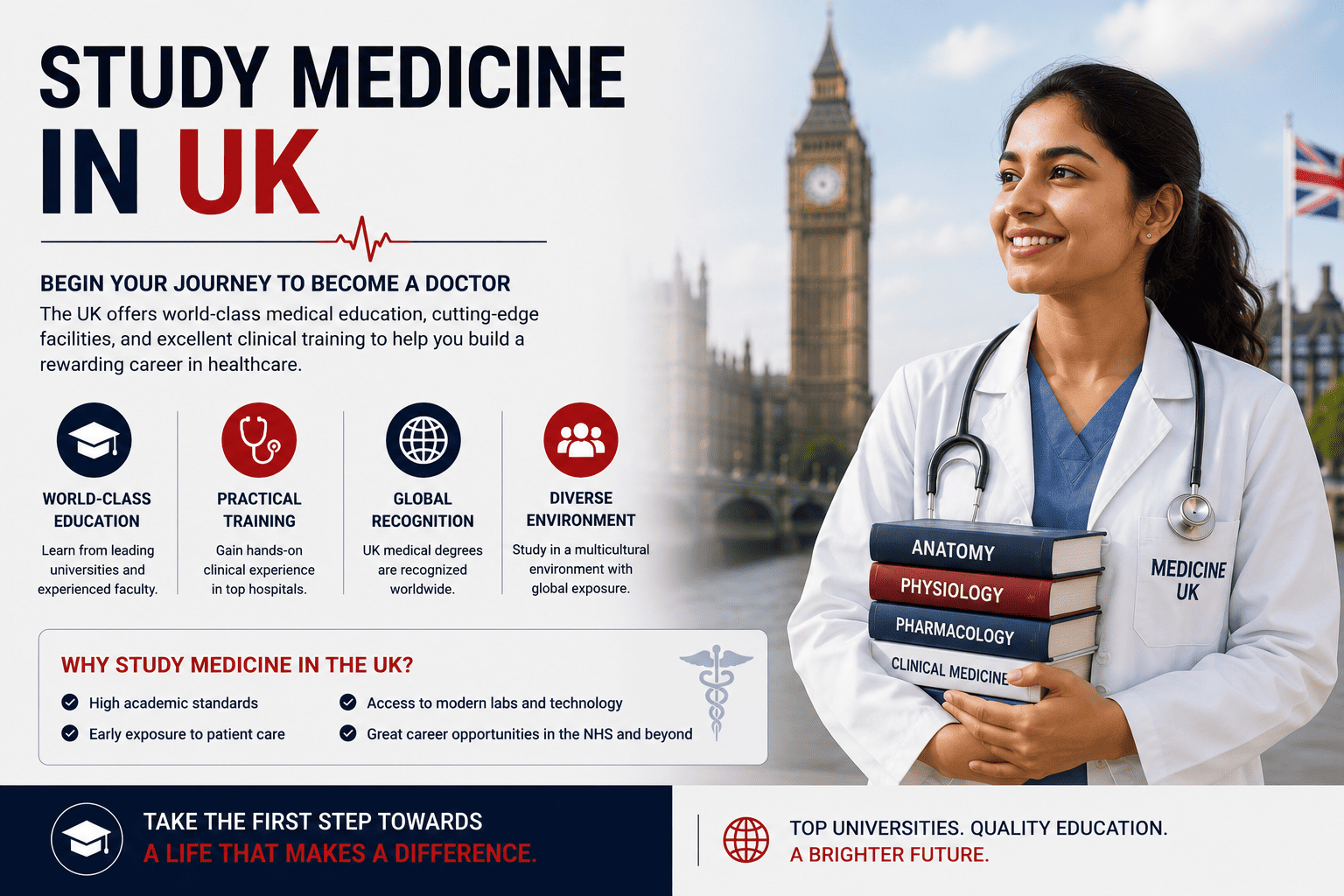
4. Medicine
Medicine is one of the most demanding and financially rewarding undergraduate programmes in UK, combining clinical training with scientific research. According to HESA Graduate Outcomes data, Medicine and Dentistry graduates earn the highest average starting salary of any undergraduate subject at £43,925 (INR 55.8L) per year. Most medical schools require strong academic grades, UCAT scores, and relevant clinical experience for admission.
Details | Information |
Duration | 5–6 years (MBBS) |
Annual Tuition Fees | £35,000–£58,000 (INR 44.5L–73.7L) |
English Requirement | IELTS 7.0–7.5 |
Top Universities | University of Oxford, University of Cambridge, Imperial College London, University of Edinburgh, King's College London |
Average Starting Salary | £43,925 (INR 55.8L) per year |
Top Career Roles | Doctor, Surgeon, Medical Researcher, Psychiatrist, Public Health Physician |
5. Law
Law in UK is a three-year undergraduate degree covering the seven foundation subjects required by the Solicitors Regulation Authority and Bar Standards Board. Oxford ranks second globally for Law in the QS subject rankings 2026, with Cambridge third, LSE seventh, and UCL ninth. According to ISE 2024 data, Law has the highest average starting salary of any graduate sector at approximately £43,508 (INR 55.3L).
Details | Information |
Duration | 3 years (LLB) |
Annual Tuition Fees | £18,000–£45,000 (INR 22.9L–57.2L) |
English Requirement | IELTS 6.5–7.5 |
Top Universities | University of Oxford, University of Cambridge, London School of Economics, UCL, King's College London |
Average Starting Salary | £27,690–£43,508 (INR 35.2L–55.3L) per year |
Top Career Roles | Solicitor, Barrister, Legal Counsel, Compliance Officer, Human Rights Lawyer |
Top Masters Courses to Study in UK
Postgraduate taught master's programmes in UK are predominantly one year in duration, making them one of the most time-efficient postgraduate routes available globally. For international students, postgraduate tuition fees range from £13,000 (INR 16.5L) to £60,000 (INR 76.2L) per year depending on the course and institution. Below are the most career-relevant and widely chosen master's programmes across UK universities.
1. MBA and Business Management
An MBA in UK is one of the most globally respected postgraduate qualifications available, combining leadership, strategy, finance, and operations within a one-year intensive format. According to the High Flyers Graduate Market 2026 report, the median graduate starting salary at top UK employers is £35,000 (INR 44.5L), with MBA graduates at London Business School and Oxford Saïd consistently commanding salaries well above this benchmark.
Details | Information |
Duration | 1–2 years |
Annual Tuition Fees | £25,000–£60,000 (INR 31.8L–76.2L) |
English Requirement | IELTS 6.5–7.0 |
Top Universities | London Business School, Oxford Saïd, Cambridge Judge, Warwick Business School, Imperial College Business School |
Average Starting Salary | £55,000–£90,000 (INR 69.9L–1.14Cr) |
Top Career Roles | Management Consultant, Strategy Director, Business Development Manager, COO, Entrepreneur |
2. Data Science and Artificial Intelligence
Data Science and AI is the fastest-growing postgraduate subject in UK, driven by employer demand across technology, finance, healthcare, and government. Programmes combine machine learning, statistical modelling, natural language processing, and data engineering, with strong research links at institutions including Imperial, Edinburgh, and Manchester. ISE data shows Digital and IT roles offering average starting salaries near £34,475 (INR 43.8L) at entry level, rising sharply with experience.
Details | Information |
Duration | 1 year |
Annual Tuition Fees | £18,000–£36,000 (INR 22.9L–45.7L) |
English Requirement | IELTS 6.5 |
Top Universities | Imperial College London, University of Edinburgh, University of Manchester, UCL, University of Warwick |
Average Starting Salary | £34,475–£50,000 (INR 43.8L–63.5L) per year |
Top Career Roles | Data Scientist, ML Engineer, AI Researcher, Data Analyst, Business Intelligence Manager |
3. Computer Science and Information Technology
MSc Computer Science in UK is a one-year conversion or advanced programme covering software engineering, cybersecurity, cloud computing, and systems design. It is available at both specialist and broad-based universities, with options for students from non-computing undergraduate backgrounds through dedicated conversion MSc routes. HESA data shows IT graduates earning a median of £29,120 (INR 37L) per year at entry level.
Details | Information |
Duration | 1 year |
Annual Tuition Fees | £16,000–£34,000 (INR 20.3L–43.2L) |
English Requirement | IELTS 6.5 |
Top Universities | University of Oxford, University of Cambridge, Imperial College London, University of Bristol, University of Southampton |
Average Starting Salary | £29,120–£34,475 (INR 37L–43.8L) per year |
Top Career Roles | Software Developer, Cybersecurity Analyst, Cloud Architect, Systems Engineer, IT Consultant |
4. Engineering and Technology
Postgraduate Engineering programmes in UK are available across a wide range of disciplines including sustainable energy, advanced manufacturing, aerospace systems, and structural engineering. Most MEng and MSc programmes are accredited by the relevant professional body, supporting progression toward Chartered Engineer status. HESA data records Engineering and Technology graduates earning an average of £31,975 (INR 40.6L) at graduate entry level.
Details | Information |
Duration | 1–2 years |
Annual Tuition Fees | £18,000–£36,000 (INR 22.9L–45.7L) |
English Requirement | IELTS 6.5 |
Top Universities | Imperial College London, University of Cambridge, University of Oxford, University of Sheffield, University of Bath |
Average Starting Salary | £31,695–£36,115 (INR 40.3L–45.9L) per year |
Top Career Roles | Structural Engineer, Energy Systems Engineer, Aerospace Engineer, Manufacturing Manager, R&D Engineer |
5. Public Health and Healthcare Management
MSc Public Health and Healthcare Management programmes in UK are accredited by leading public health bodies and draw strongly on the NHS infrastructure for practical learning. The programmes cover epidemiology, health policy, healthcare finance, and population health strategy. Graduate roles span NHS management, global health organisations, NGOs, and government health departments, with the sector offering stable and growing career pathways.
Details | Information |
Duration | 1 year |
Annual Tuition Fees | £16,000–£30,000 (INR 20.3L–38.1L) |
English Requirement | IELTS 6.5–7.0 |
Top Universities | London School of Hygiene and Tropical Medicine, UCL, University of Edinburgh, University of Manchester, King's College London |
Average Starting Salary | £30,000–£45,000 (INR 38.1L–57.2L) per year |
Top Career Roles | Public Health Analyst, Healthcare Manager, Health Policy Advisor, Epidemiologist, NHS Manager |
Top UK Universities for Popular Courses
UK universities consistently perform well in global subject rankings across a wide range of disciplines. Below is a quick reference overview of the leading institutions by subject area:
Subject | Top UK University |
Business and Management | London School of Economics |
Computer Science | University of Oxford |
Engineering | Imperial College London |
Medicine | University of Oxford |
Law | University of Oxford |
Economics | London School of Economics |
Psychology | University of Cambridge |
Architecture | University of Cambridge |
Data Science and AI | Imperial College London |
Project Management | Cranfield University |
Also read: Free Education in UK for Indian Students 2026
Eligibility Requirements for Studying Popular Courses in UK
Eligibility requirements vary by course level, subject area, and university tier. Below is a consolidated overview of the standard entry criteria across the most popular programmes.
Programme Level | Academic Requirement | English Requirement |
Undergraduate (Arts, Business, Social Sciences) | Class 12 with 75%–85%+ | IELTS 6.0–6.5 / TOEFL 79–90 |
Undergraduate (STEM, Medicine, Law) | Class 12 with 85%–90%+ | IELTS 6.5–7.5 / TOEFL 90–110 |
Postgraduate Taught Master's (General) | Bachelor's degree with 2:2 minimum | IELTS 6.5 / TOEFL 90 |
Postgraduate Taught Master's (Competitive) | Bachelor's degree with 2:1 or first-class | IELTS 7.0–7.5 / TOEFL 100–110 |
PhD / Research Programmes | Master's degree or strong bachelor's with research experience | IELTS 7.0+ / TOEFL 100+ |
Also check: Study in UK Without IELTS
Cost of Studying Different Courses in UK
Tuition fees in UK vary significantly by subject area, university tier, and programme level. Below is a consolidated cost overview across the most popular course categories for international students.
Course | UG Annual Tuition Fees | PG Annual Tuition Fees |
Business and Management | £12,000–£28,000 (INR 15.2L–35.6L) | £18,000–£60,000 (INR 22.9L–76.2L) |
Computer Science | £16,000–£35,000 (INR 20.3L–44.5L) | £16,000–£34,000 (INR 20.3L–43.2L) |
Engineering | £18,000–£36,000 (INR 22.9L–45.7L) | £18,000–£36,000 (INR 22.9L–45.7L) |
Medicine | £35,000–£58,000 (INR 44.5L–73.7L) | £25,000–£50,000 (INR 31.8L–63.5L) |
Law | £18,000–£45,000 (INR 22.9L–57.2L) | £19,500–£55,600 (INR 24.8L–70.7L) |
Economics and Finance | £15,000–£35,000 (INR 19.1L–44.5L) | £20,000–£38,000 (INR 25.4L–48.3L) |
Psychology | £14,000–£28,000 (INR 17.8L–35.6L) | £14,000–£28,000 (INR 17.8L–35.6L) |
Architecture | £16,000–£30,000 (INR 20.3L–38.1L) | £16,000–£28,000 (INR 20.3L–35.6L) |
Data Science and AI | £16,000–£32,000 (INR 20.3L–40.6L) | £18,000–£36,000 (INR 22.9L–45.7L) |
Project Management | N/A | £14,000–£36,800 (INR 17.8L–46.7L) |
In addition to tuition, students should budget £10,000 to £22,000 (INR 12.7L–27.9L) per year for cost of living in UK, with London-based students sitting at the higher end of this range.
Must check: Scholarships to Study in UK
Career Opportunities After Studying in UK
UK degrees are globally recognised and consistently deliver strong graduate employment outcomes across all major subject areas. According to HESA Graduate Outcomes data, 88% of 2022/23 graduates were in work or further study within 15 months of graduating, with 76% employed in high-skilled roles. This strong employability record also contributes to the growing demand for jobs in UK for Indians, particularly in sectors such as technology, finance, healthcare, engineering, and business management.
Course | Average Starting Salary | Top Career Sectors |
Business and Management | £30,190 (INR 38.3L) | Consulting, Finance, Marketing, Operations |
Computer Science | £29,120–£34,475 (INR 37L–43.8L) | Technology, Fintech, Cybersecurity, AI |
Engineering | £31,695–£36,115 (INR 40.3L–45.9L) | Infrastructure, Aerospace, Energy, Manufacturing |
Medicine | £43,925 (INR 55.8L) | NHS, Private Practice, Research, Public Health |
Law | £27,690–£43,508 (INR 35.2L–55.3L) | Commercial Law, Government, Compliance, Arbitration |
Economics and Finance | £35,750 (INR 45.4L) | Investment Banking, Policy, Consulting, Risk |
Data Science and AI | £34,475–£50,000 (INR 43.8L–63.5L) | Technology, Finance, Healthcare, Government |
Psychology | £26,485 (INR 33.6L) | Healthcare, HR, Research, Education |
Marketing | £27,930 (INR 35.5L) | Digital Agencies, Corporates, Startups, Media |
Project Management | £38,000–£65,000 (INR 48.3L–82.6L) | Construction, IT, Consulting, Government |
Also check: Jobs in UK after MBA for Indian Students in 2026
How to Choose the Right Course in UK
Picking the right course is one of the most important decisions international students make before applying to UK universities, and it deserves more thought than most people give it. Here is a practical framework to help make that decision with confidence.
· Align the Course with Your Career Goal: Start with where you want to be in five years, not the subject you liked most in school. If the career goal is investment banking, Economics or Finance at LSE or Warwick makes more sense than a general Business degree. If it is software development, a specialised Computer Science degree from a research-active institution will open more doors than a broad IT programme.
· Check Subject Rankings, Not Just Overall Rankings: A university ranked 200th globally might rank in the top 20 for your specific subject. Always cross-reference the QS World University Rankings by Subject 2026 for your chosen field, as the subject ranking is more relevant to employer perception than the overall institutional position.
· Understand the Visa and Work Rights Picture: The Graduate Route Visa currently allows two years of post-study work after graduation, but students applying on or after January 2027 will only receive 18 months for master's graduates. Choosing a programme that finishes before December 2026 and applying for the Graduate Route early maximises your post-study window.
· Factor in Total Cost, Not Just Tuition: Tuition fees are only part of the picture. A £20,000 (INR 25.4L) programme in London with £22,000 (INR 27.9L) in annual living costs adds up to more than a £28,000 (INR 35.6L) programme in Manchester where living costs run to £12,000 (INR 15.2L) per year. Calculate the full two or three-year cost before comparing options.
· Look at Graduate Employment Outcomes: HESA publishes Graduate Outcomes data annually showing what graduates from specific subjects at specific universities actually earn and do after graduation. This is far more useful than general rankings when assessing whether a programme delivers on its promises.
· Apply Early and in Multiple Rounds: UK undergraduate applications go through UCAS, with the most competitive programmes at Oxford and Cambridge requiring applications by 15 October. For postgraduate programmes, most universities open applications in October and close them between January and June. Applying in the first available window consistently improves both admission and scholarship outcomes across all subject areas and university tiers.
Must check: Indian Student Packing List for UK
Conclusion
Choosing from the best courses to study in UK comes down to matching your career direction with the right subject, university, and budget. From medicine and law to data science and project management, UK offers strong academic depth paired with genuine graduate employment outcomes across nearly every field. Students who research subject rankings carefully, account for total costs beyond tuition, and apply within the earliest admission windows consistently secure the strongest results. With clear planning, the courses to study in UK in 2026 can deliver real, measurable career value well beyond graduation.
If you want clarity on your next steps, you can book a free counseling session with experts. Someone from the team will walk you through your options and answer your questions.
Popular Courses from Top Universities for MS in USA