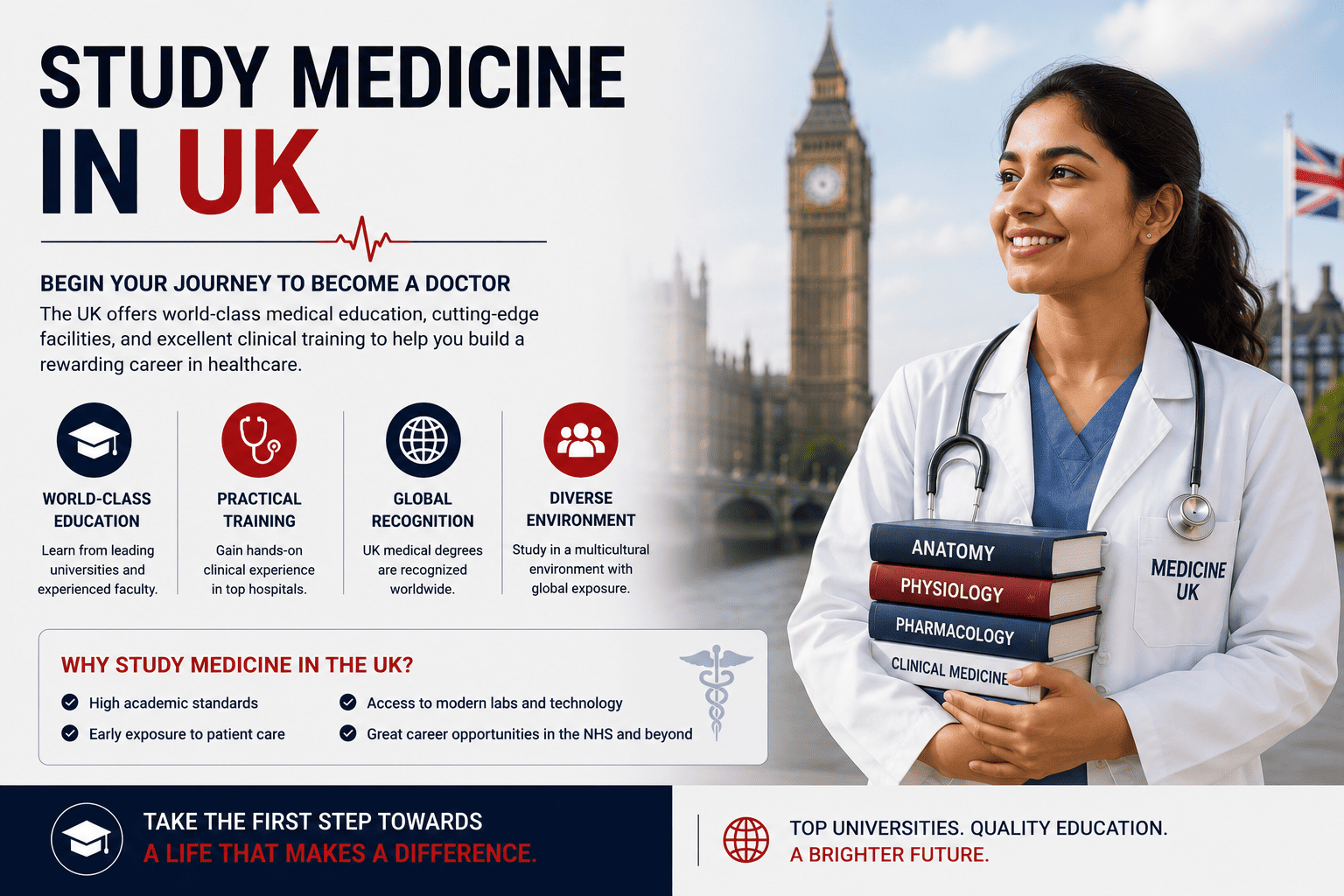

Study MBBS in UK
Table of Contents
- Why Study MBBS in UK?
- Top Universities to Study MBBS in UK
- Course Structure of MBBS in UK
- Eligibility and Admission Requirements to Study MBBS in UK
- Cost of Study MBBS in UK
- Cost of Living in UK for Medical Students
- Top Scholarships to Study MBBS in UK
- UCAS Application Process for Study MBBS in UK
- UK Student Visa Requirements for MBBS
- Work Opportunities While Studying MBBS in UK
- Career Opportunities After Study MBBS in UK
- Conclusion
Study MBBS in UK offers a globally recognised medical education delivered through NHS-integrated clinical training and accredited by the General Medical Council. Programmes typically run for five to six years, combining biomedical sciences in the early years with increasing clinical rotations from Year 3 onwards.
Tuition fees for international students range from approximately Rs. 39.62L to Rs. 62.26L per year depending on the UK universities, while living costs average Rs. 13.58L to Rs. 22.64L per year outside London. Indian students must meet high academic standards in science subjects, clear the UCAT or BMAT entrance examination, and demonstrate relevant healthcare work experience before applying through UCAS.
Key Highlights of Study MBBS in UK:
Key Highlights | Details |
Programme Duration | 5 to 6 years full-time (including intercalated year at some universities) |
Degree Awarded | MBBS or MBChB depending on the institution |
Accreditation | General Medical Council (GMC) accredited |
Approx. Annual Tuition Fees | GBP 35,000–55,000/year (approx. Rs. 39.62L–Rs. 62.26L/year) |
Top Universities | University of Oxford, University of Cambridge, Imperial College London, UCL, University of Edinburgh |
Entrance Tests | UCAT (most universities); BMAT (select universities) |
Core Clinical Training | NHS hospitals and community settings from Year 3 |
Post-Study Work Option | Graduate Route Visa up to 2 years; Foundation Programme for GMC-registered graduates |
Career Outcomes | NHS Foundation Doctor, GP, Hospital Specialist, Medical Researcher |
Scholarship Options | Chevening, Commonwealth, university bursaries |
Must check: Study Medicine in UK
Why Study MBBS in UK?
The UK remains one of the most sought-after destinations for medical education due to its globally recognized qualifications, strong clinical training, and clear career pathways.
Key reasons to study MBBS in UK:
Globally Recognized Degree: UK medical qualifications are accepted by medical councils and licensing bodies in countries such as India, Australia, Canada, and across the Middle East.
Clinical Training Through the NHS: Students gain hands-on experience within the National Health Service (NHS), one of the world's largest healthcare systems.
Top-Ranked Medical Schools: Universities such as the University of Oxford, the University of Cambridge, Imperial College London, and University College London consistently rank among the world's leading institutions for medicine.
GMC Accreditation: UK medical degrees are regulated and accredited by the General Medical Council (GMC), ensuring high academic and clinical standards.
Direct Access to Foundation Training: Graduates can progress into the UK Foundation Programme, a structured two-year clinical training pathway after completing their degree.
Strong Research and Innovation Environment: Medical students benefit from exposure to advanced research, clinical trials, and evidence-based healthcare practices.
Multicultural Learning Experience: UK medical schools attract students and faculty from around the world, creating a diverse learning environment.
Post-Study Work Opportunities: The Graduate Route Visa allows eligible graduates to stay and work in the UK for up to two years after completing their degree.
Excellent Career Prospects: A UK medical degree opens pathways to careers in clinical practice, research, public health, and specialist training worldwide.
Top Universities to Study MBBS in UK
UK medical schools are accredited by the General Medical Council, and all offer clinical training through NHS partnerships. QS rankings and GMC accreditation status are the two most reliable benchmarks when evaluating medical schools for international applicants.
University | QS World Ranking 2026 | Approx. Annual Tuition (International) |
University of Oxford | #4 | GBP 39,000–45,000 (approx. Rs. 44.15L–Rs. 50.93L) |
University of Cambridge | #6 | GBP 39,000–45,000 (approx. Rs. 44.15L–Rs. 50.93L) |
Imperial College London | #2 | GBP 42,000–52,000 (approx. Rs. 47.54L–Rs. 58.87L) |
University College London | #9 | GBP 40,000–50,000 (approx. Rs. 45.28L–Rs. 56.6L) |
University of Edinburgh | #34 | GBP 38,000–48,000 (approx. Rs. 43.02L–Rs. 54.34L) |
King's College London | #31 | GBP 38,000–50,000 (approx. Rs. 43.02L–Rs. 56.6L) |
University of Manchester | #35 | GBP 35,000–46,000 (approx. Rs. 39.62L–Rs. 52.08L) |
University of Bristol | #51 | GBP 35,000–45,000 (approx. Rs. 39.62L–Rs. 50.93L) |
Course Structure of MBBS in UK
Understanding the course structure helps students assess what the full commitment of a UK medical degree looks like. Most MBBS or MBChB programmes are structured across five to six years, moving from biomedical sciences in the early years to increasing clinical immersion in hospital and community settings.
Year-by-Year Programme Structure
The early years focus on building a strong biomedical science foundation before clinical contact begins. Later years are spent almost entirely in NHS clinical environments across multiple specialties.
Year | Key Focus Areas |
Year 1 and 2 | Anatomy, physiology, biochemistry, pharmacology, medical ethics, early patient contact |
Year 3 | Introduction to clinical medicine; patient history taking; clinical skills; NHS placement begins |
Year 4 | Core clinical rotations across surgery, medicine, paediatrics, obstetrics, psychiatry |
Year 5 | Advanced clinical rotations; specialty placements; elective period |
Year 6 (where applicable) | Sub-internship; clinical leadership; preparation for Foundation Programme |
Intercalated Year (optional) | BSc or MSc in a biomedical science subject; available at most universities |
Popular Specialty Pathways After MBBS in UK
Most graduates enter the UK Foundation Programme immediately after graduation before choosing a specialty training pathway. Common specialty directions include internal medicine, surgery, general practice, psychiatry, and academic medicine.
Specialty Pathway | Training Duration After Foundation | Typical Work Setting |
General Practice (GP) | 3 years specialty training | Community clinics, NHS GP surgeries |
Internal Medicine | 3 to 7 years depending on subspecialty | NHS hospitals, teaching hospitals |
Surgery | 6 to 8 years depending on subspecialty | NHS surgical centres, teaching hospitals |
Psychiatry | 3 to 6 years | NHS mental health trusts, community settings |
Paediatrics | 3 to 8 years | NHS children's hospitals, general hospitals |
Academic Medicine and Research | Variable | Universities, research institutes |
Eligibility and Admission Requirements to Study MBBS in UK
Admission requirements for MBBS in UK are among the most demanding in higher education globally, covering academic grades, entrance examinations, work experience, and interview performance. Meeting all components well above the minimum threshold is necessary at competitive medical schools.
Academic Qualification Requirements
UK medical schools require A-Level grades or equivalent international qualifications in chemistry and biology as a minimum. Most competitive universities expect A*AA or AAA at A-Level, with equivalent international grade benchmarks for Indian students applying with 12th-standard results.
University Tier | Academic Requirements |
Top Medical Schools (Oxford, Cambridge, Imperial) | AAA to AA*A at A-Level; Chemistry and Biology required; equivalent international grades expected |
Strong Medical Schools (UCL, Edinburgh, King's) | AAA at A-Level; Chemistry and at least one other science; strong international equivalents |
Other Medical Schools (Manchester, Bristol, others) | AAA to ABB at A-Level; Chemistry required; Biology and another science preferred |
Entrance Examination Requirements
Most UK medical schools require either UCAT or BMAT as part of the admissions process. Knowing which test applies to each shortlisted university is essential before registering, as preparation timelines and test windows are fixed.
Test | Full Name | Universities Using It |
UCAT | University Clinical Aptitude Test | Most UK medical schools including Edinburgh, King's, Manchester, Bristol |
BMAT | BioMedical Admissions Test | Oxford, Cambridge, Imperial (check current status as BMAT has been phased out at some) |
Work Experience and Other Requirements
UK medical schools place significant weight on demonstrable healthcare exposure and understanding of the medical profession. This component is assessed through the personal statement and interview and is not optional at any competitive medical school.
Requirement | Detail |
Healthcare Work Experience | Shadowing a doctor, volunteering in a hospital, care home, or community health setting |
Personal Statement | 4,000 characters; covers motivation for medicine, work experience, and personal qualities |
Medical School Interview | MMI or panel format at most universities; tests communication, ethics, and clinical reasoning |
English Language | IELTS 7.0 or above; TOEFL iBT 100 or above for non-native English speakers |
References | School or college reference required through UCAS |
Cost of Study MBBS in UK
The total cost of studying MBBS in UK includes tuition fees, accommodation, food, transport, health insurance through the Immigration Health Surcharge, books, clinical equipment, and personal expenses. UK medical training is among the more expensive globally, particularly at London-based institutions.
Tuition Fees for MBBS in UK
Tuition fees for international students pursuing MBBS in UK are set by each institution and updated annually. London universities generally charge at the higher end, while universities in Edinburgh, Manchester, and Bristol offer slightly lower fee structures.
University | Approx. Annual Tuition (International) | INR Value |
University of Oxford | GBP 39,000–45,000/year | Rs. 44.15L–Rs. 50.93L/year |
University of Cambridge | GBP 39,000–45,000/year | Rs. 44.15L–Rs. 50.93L/year |
Imperial College London | GBP 42,000–52,000/year | Rs. 47.54L–Rs. 58.87L/year |
University College London | GBP 40,000–50,000/year | Rs. 45.28L–Rs. 56.6L/year |
University of Edinburgh | GBP 38,000–48,000/year | Rs. 43.02L–Rs. 54.34L/year |
University of Manchester | GBP 35,000–46,000/year | Rs. 39.62L–Rs. 52.08L/year |
Cost of Living in UK for Medical Students
Cost of living in UK varies significantly by city. London is among the most expensive cities in Europe for day-to-day living, particularly when it comes to accommodation and transportation. In contrast, medical students studying in cities such as Edinburgh, Manchester, or Bristol often benefit from lower living expenses while still accessing high-quality medical education and clinical training opportunities.
Expense Category | London (Monthly) | Other UK Cities (Monthly) |
Accommodation | GBP 1,200–2,200 (approx. Rs. 1.36L–Rs. 2.49L) | GBP 600–1,100 (approx. Rs. 67,920–Rs. 1.24L) |
Food and Groceries | GBP 300–500 (approx. Rs. 33,960–Rs. 56,600) | GBP 200–350 (approx. Rs. 22,640–Rs. 39,620) |
Transport | GBP 150–250 (approx. Rs. 16,980–Rs. 28,300) | GBP 60–120 (approx. Rs. 6,792–Rs. 13,584) |
Clinical Equipment and Books | GBP 100–200/year one-off (approx. Rs. 11,320–Rs. 22,640) | Same |
Health Insurance (IHS) | GBP 776/year (approx. Rs. 87,888/year) | Same |
Total Annual Living Cost | GBP 22,000–38,000 (approx. Rs. 24.9L–Rs. 43.02L) | GBP 12,000–20,000 (approx. Rs. 13.58L–Rs. 22.64L) |
Source: Numbeo
Must check: Education Loan to Study in UK
Top Scholarships to Study MBBS in UK
Several scholarship options are available for international students planning to pursue an MBBS in the UK. These Scholarships to Study in UK can help reduce tuition and living expenses, although most are highly competitive. Successful applicants typically demonstrate strong academic performance, leadership potential, and submit well-prepared applications well before the scholarship deadlines.
Scholarship | Eligibility | Coverage |
Chevening Scholarship | International students with 2 or more years of work experience; strong academic record; leadership potential | Full tuition, living stipend, return airfare, visa costs |
Commonwealth Scholarships | Students from eligible Commonwealth countries; strong academic merit and financial need | Full tuition, return airfare, living allowance |
GREAT Scholarships | Indian students at participating UK universities; varies by institution | GBP 10,000 (approx. Rs. 11.32L) toward tuition |
University Bursaries and Hardship Funds | Enrolled international students; financial need assessed | Partial financial support; varies by university |
Oxford Crankstart Scholarship | Students at University of Oxford from lower-income backgrounds | Annual bursary plus internship support |
Gates Cambridge Scholarship | Outstanding applicants to the University of Cambridge | Fully funded: tuition and living expenses |
UCAS Application Process for Study MBBS in UK
Applying to study MBBS in UK goes through UCAS, the centralised UK university admissions system, with a strict annual timeline and a maximum of four medical school choices per application. Starting preparation at least 18 months before the intended entry year is the most practical approach.
Step | What to Do | Tip |
Step 1: Research Universities | Shortlist four medical schools based on entry requirements, UCAT or BMAT usage, and location | Check each school's specific requirements on official websites |
Step 2: Gain Work Experience | Complete healthcare shadowing and volunteering | Start at least 12 to 18 months before applying |
Step 3: Register for UCAT or BMAT | Sit the relevant entrance exam for shortlisted schools | UCAT opens registration in May; test window runs July to October |
Step 4: Write Personal Statement | Draft and refine the 4,000-character UCAS personal statement | Focus on work experience, motivation, and self-reflection |
Step 5: Submit UCAS Application | Submit through UCAS by the medical school deadline | Medical school UCAS deadline is 15 October |
Step 6: Attend Interviews | Prepare for MMI or panel-format interviews | Most interviews run November to February |
Step 7: Receive and Accept Offer | Accept conditional or unconditional offer through UCAS | Most offers are conditional on final exam grades |
Step 8: Meet Conditions | Achieve required A-Level or equivalent grades | Results day in August typically confirms offers |
Step 9: Apply for Student Visa | Apply for UK Student Visa via UKVI with CAS letter | Apply at least 3 months before programme start date |
UK Student Visa Requirements for MBBS
Every international student admitted to a UK medical school must apply for a UK Student Visa before travelling. The application is submitted through the UKVI portal after receiving the Confirmation of Acceptance for Studies from the university.
Requirement | Detail | Approx. Amount |
CAS Letter | Confirmation of Acceptance for Studies from the university | Required |
UK Student Visa Application | Submitted via UKVI portal | GBP 363 (approx. Rs. 41,090) |
Immigration Health Surcharge | Paid upfront for full programme duration | GBP 776/year (approx. Rs. 87,888/year) |
Proof of Financial Funds | Tuition plus living costs for first year | GBP 12,000–38,000 depending on city |
English Language Test | IELTS 7.0 or above; TOEFL iBT 100 or above | University-specific |
TB Test Certificate | Required for applicants from India | Required |
Academic Documents | Transcripts, grade certificates, entrance test scores | Required |
Passport | Valid for full duration of the programme | Required |
Note: After completing MBBS in UK, eligible international graduates can apply for the Graduate Route Visa, allowing them to remain in the UK for up to two years to work or look for work. Graduates who enter the UK Foundation Programme must also register with the GMC.
Work Opportunities While Studying MBBS in UK
International students on a UK Student Visa are permitted to work part-time during term time and full-time during official university holidays. For medical students, on-campus and NHS-adjacent roles provide both income and relevant professional exposure during the programme.
Role | Work Limit | Approx. Hourly Rate |
Healthcare Assistant | 20 hours/week during term | GBP 11–14/hour (approx. Rs. 1,245–Rs. 1,585/hour) |
Medical Receptionist | 20 hours/week during term | GBP 10–13/hour (approx. Rs. 1,132–Rs. 1,472/hour) |
Campus or Admin Support | 20 hours/week during term | GBP 10–13/hour (approx. Rs. 1,132–Rs. 1,472/hour) |
Research Assistant | 20 hours/week during term | GBP 12–16/hour (approx. Rs. 1,358–Rs. 1,811/hour) |
Tutoring | 20 hours/week during term | GBP 15–30/hour (approx. Rs. 1,698–Rs. 3,396/hour) |
Note: Medical students should balance part-time work carefully against the significant academic and clinical demands of the MBBS programme. Part-time earnings help with living costs but should not be relied upon to cover tuition fees,
Career Opportunities After Study MBBS in UK
Graduates who study MBBS in UK and register with the GMC can enter the UK Foundation Programme directly after graduation, which is a structured two-year clinical training pathway across multiple specialties. After completing the Foundation Programme, doctors can progress into specialty training, general practice training, or academic medicine pathways.
These opportunities also contribute to the growing demand for jobs in UK for Indians, particularly in the healthcare sector where qualified medical professionals are highly valued. NHS doctor salaries in the UK in 2026 increase steadily through training grades, with consultant-level positions offering significantly higher compensation over time.
Career Stage | Approximate Annual Salary | INR Value |
Foundation Year 1 Doctor | GBP 32,000–36,000 | Rs. 36.22L–Rs. 40.75L |
Foundation Year 2 Doctor | GBP 36,000–40,000 | Rs. 40.75L–Rs. 45.28L |
Core or Specialty Trainee | GBP 40,000–58,000 | Rs. 45.28L–Rs. 65.65L |
Specialty Registrar | GBP 55,000–80,000 | Rs. 62.26L–Rs. 90.56L |
NHS Consultant | GBP 93,000–126,000 | Rs. 1.05Cr–Rs. 1.43Cr |
GP Partner | GBP 70,000–110,000 | Rs. 79.24L–Rs. 1.24Cr |
Source: Glassdoor
Conclusion
Study MBBS in UK offers international students one of the most globally respected medical qualifications available, delivered through NHS-integrated clinical training and accredited by the General Medical Council. With top-ranked medical schools including Oxford, Cambridge, Imperial, and UCL, and a structured post-graduation pathway through the Foundation Programme and Graduate Route Visa, pursuing MBBS in UK in 2026 builds both clinical excellence and genuine international career mobility.
The total cost includes tuition of approximately GBP 35,000 to GBP 55,000 per year (approx. Rs. 39.62L to Rs. 62.26L per year) and living expenses of approximately GBP 12,000 to GBP 38,000 per year (approx. Rs. 13.58L to Rs. 43.02L per year) depending on the city. Students who prepare early, build strong work experience, and apply through UCAS by the October deadline give themselves the strongest chance of securing a place at a GMC-accredited UK medical school.
If you want clarity on your next steps, you can book a free counseling session with experts. Someone from the team will walk you through your options and answer your questions.