
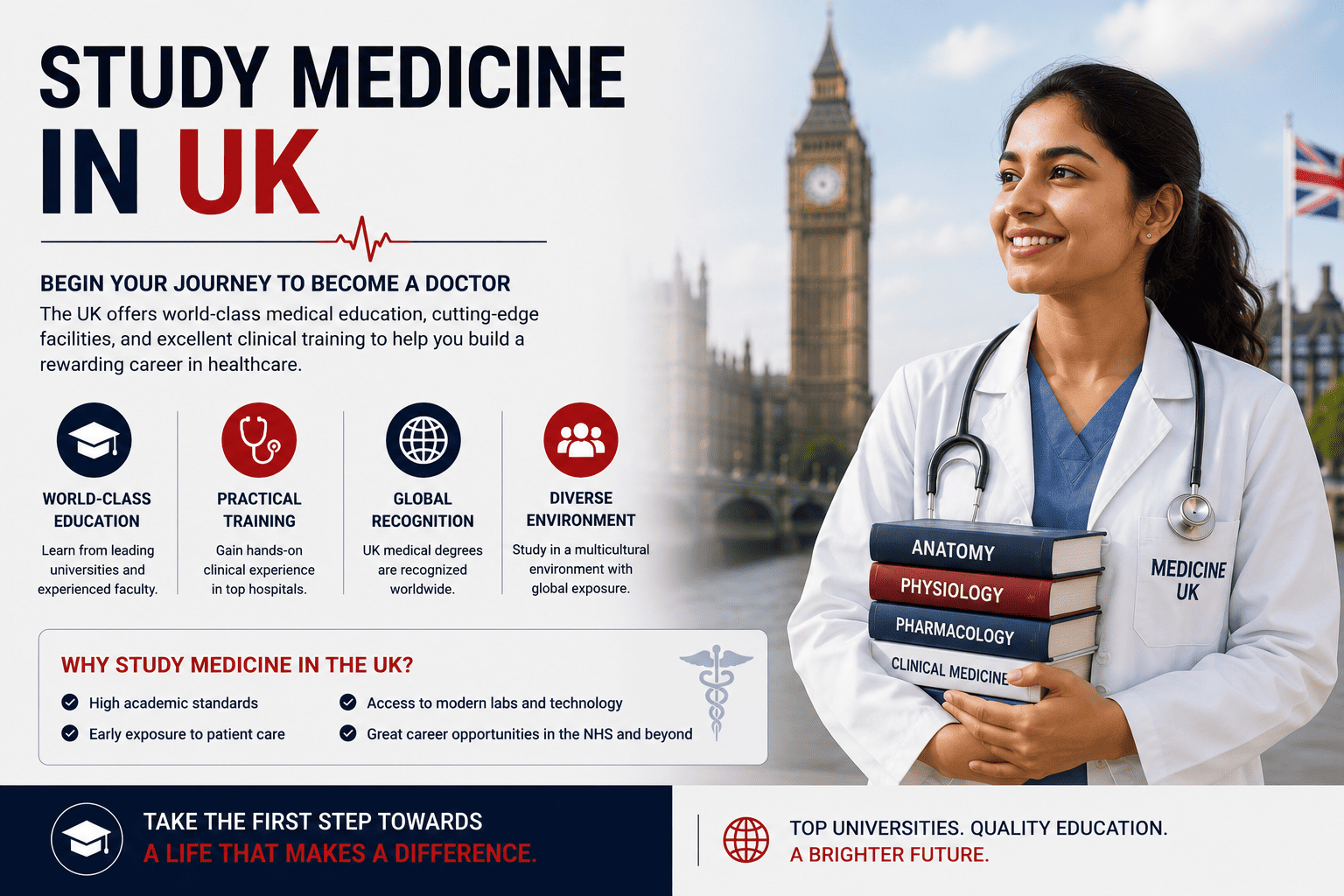
Study Medicine in UK
Table of Contents
- Why Study Medicine in UK
- Education System for Study Medicine in UK
- Top Universities for Study Medicine in UK
- Acceptance Rate for Study Medicine in UK
- Admission Requirements for Study Medicine in UK
- Cost of Studying Medicine in UK
- Study Medicine in UK Scholarships
- Study Medicine in UK Intakes and Admission Deadlines
- How to Apply for Study Medicine in UK
- Student Visa Requirements for Study Medicine in UK
- Top Cities for Study Medicine in UK Students
- Career Opportunities After Study Medicine in UK
- Top Recruiters After Study Medicine in UK
- Conclusion
Medicine in UK a well respected pathway for students aspiring to become globally recognized medical professionals. Medical programs in UK takes 5–6 years for an undergraduate degree (MBBS/MBChB) or 4 years for graduate entry. These English taught programs require strong academic performance and entrance test scores. The tuition fees range between £25,000 to £60,000 per year (₹29 lakh–₹70 lakh approx.)
The table below provides a quick overview of study medicine in UK.
Particulars | Details |
Degree Awarded | MBBS / MBChB / BMBS |
Course Duration | 5–6 Years |
Language of Instruction | English |
Annual Tuition Fees | £25,000–60,000 (₹29 lakh–₹70 lakh) |
Annual Living Costs | £12,000–18,000 (₹14 lakh–₹21 lakh) |
Popular Intake | September |
IELTS Requirement | 7.0–7.5 |
Entrance Exams | UCAT, BMAT (Selected Universities) |
Clinical Training | NHS Hospitals |
Graduate Visa | Up to 2 Years |
Average Doctor Salary | £35,000–100,000+ (₹41 lakh–₹1.17 crore+) |
This blog covers all you need to know about studying medicine in UK, including top medical universities, eligibility requirements, tuition fees, scholarships, student visas and career opportunities after graduation. Students can use this information to compare universities, estimate study costs, and plan their medical education journey effectively
Why Study Medicine in UK
UK medical schools emphasize clinical exposure, research and evidence based practice preparing future doctors for global healthcare systems. UK offers access to world class medical education, advanced healthcare infrastructure, access to the NHS, and opportunities to practice medicine internationally. Major benefits of studying medicine in UK:
Globally recognized medical degrees
Extensive NHS clinical training
Early patient exposure
Strong research opportunities
Access to advanced healthcare facilities
Excellent career prospects
Opportunities for specialization
International recognition of qualifications
Education System for Study Medicine in UK
Medical education in UK follows a structural approach progressing in phase, pre-clinical and clinical phases before graduating as qualified medical practitioners. UK's medical training system ensures that graduates possess strong clinical competencies and professional skills. The table below outlines the structure of medical education:
Stage | Duration | Focus Area |
Pre-Clinical Phase | 2–3 Years | Basic Medical Sciences |
Clinical Phase | 2–3 Years | Hospital Placements and Patient Care |
Foundation Training | 2 Years | Practical Medical Training |
Medical Degree Structure for Study Medicine in UK
Medical programs in UK are designed to develop scientific knowledge, clinical expertise, and professional ethics through a progressive curriculum.
Program | Duration |
Standard Medicine Program | 5 Years |
Medicine with Foundation Year | 6 Years |
Graduate Entry Medicine | 4 Years |
Credit System and Clinical Training for Study Medicine in UK
Medical degrees in UK are inclined towards practical learning through NHS hospital placements and clinical simulations. Students train across specialties including surgery, internal medicine, pediatrics and psychiatry. Clinical exposure from an early stage helps students develop diagnostic and patient management skills.
Component | Details |
Clinical Placements | NHS Hospitals |
Simulation Labs | Available |
Research Projects | Included in Many Programs |
Professional Assessments | Required |
Top Universities for Study Medicine in UK
UK universities maintain strong partnerships with NHS hospitals and research institutions. Studying at the best medical school enhances career opportunities and access to specialized training. Below table highlights leading Medicine universities for UK:
University | QS World University Rankings 2026 | Approximate Annual Tuition Fees |
University of Oxford | #4 | £45,000–60,000 (₹53 lakh–₹70 lakh) |
University of Cambridge | #6 | £40,000–67,000 (₹47 lakh–₹78 lakh) |
Imperial College London | #2 | £45,000–55,000 (₹53 lakh–₹64 lakh) |
University College London (UCL) | #9 | £35,000–50,000 (₹41 lakh–₹59 lakh) |
King's College London | #40 | £35,000–50,000 (₹41 lakh–₹59 lakh) |
University of Edinburgh | #34 | £32,000–45,000 (₹38 lakh–₹53 lakh) |
University of Manchester | #35 | £30,000–48,000 (₹35 lakh–₹56 lakh) |
University of Glasgow | #79 | £30,000–50,000 (₹35 lakh–₹59 lakh) |
Queen Mary University of London | #145 | £30,000–45,000 (₹35 lakh–₹53 lakh) |
Newcastle University | #137 | £28,000–42,000 (₹33 lakh–₹49 lakh) |
Acceptance Rate for Study Medicine in UK
Admission to medical programs in UK have limited seats. Universities evaluate applicants based on academic performance, entrance exams, interviews and extracurricular achievements. The table below categorizes universities based on competitiveness.
Category | Approximate Acceptance Rate |
Highly Competitive Medical Schools | 5–10% |
Moderately Competitive Medical Schools | 10–20% |
Relatively Accessible Medical Schools | 20–30% |
Admission Requirements for Study Medicine in UK
Medical schools in UK have stringent selection criteria to identify candidates with strong scientific aptitude and communication skills. A competitive applicant considers excellent grades, strong test scores and relevant extracurricular experiences. The table below outlines common admission requirements.
Requirement | Typical Criteria |
Academic Qualification | High School Certificate |
Subjects Required | Biology, Chemistry |
Minimum Academic Score | 85–95% |
Work Experience | Recommended |
Personal Statement | Required |
Reference Letter | Required |
Entrance Exams for Study Medicine in UK
Most medical schools require applicants to complete standardized entrance examinations that assess aptitude, reasoning, and scientific knowledge.
Test | Purpose |
UCAT | Medical Aptitude Assessment |
BMAT | Required by Selected Universities |
Interviews | MMI or Traditional Format |
English Language Requirements for Study Medicine in UK
International students must demonstrate strong English language proficiency. You can apply any of these tests:
Test | Score Requirement |
IELTS Academic | 7.0–7.5 |
TOEFL iBT | 95–110 |
PTE Academic | 65–75 |
Cost of Studying Medicine in UK
Medical degrees are generally more expensive than other undergraduate programs due to clinical training requirements. Students should plan their finances and explore scholarship opportunities to manage study costs effectively.
Annual Tuition Fees to Study Medicine in UK
University Tier | Approximate Annual Tuition Fees |
Top-Tier Universities | £45,000–67,000 (₹53 lakh–₹78 lakh) |
Mid-Tier Universities | £32,000–45,000 (₹38 lakh–₹53 lakh) |
Affordable Universities | £25,000–35,000 (₹29 lakh–₹41 lakh) |
Cost of Living in UK for Medicine Students
Living expenses vary significantly across UK cities, with London generally being more expensive than other regions.
Expense Category | Approximate Annual Cost |
Accommodation | £6,000–10,000 (₹7 lakh–₹12 lakh) |
Food and Groceries | £2,000–3,000 (₹2.3 lakh–₹3.5 lakh) |
Transportation | £800–1,500 (₹93,000–₹1.8 lakh) |
Health Surcharge | £776 (₹91,000) |
Personal Expenses | £2,000–3,500 (₹2.3 lakh–₹4.1 lakh) |
Total Approximate Cost | £12,000–18,000 (₹14 lakh–₹21 lakh)
|
Read more on living expenses in UK
Study Medicine in UK Scholarships
Medical education in UK is often expensive due to the long duration of study and extensive clinical training requirements. Universities, government bodies and external organizations provide funding opportunities to support deserving international students. Students with strong academic performance, leadership skills, and financial need may improve their chances of securing scholarships.
The table below highlights popular scholarships available for students planning to study medicine in UK.
Scholarship | Eligibility | Coverage |
Chevening Scholarships | Leadership Potential and Academic Excellence | Full Tuition, Living Expenses, Travel |
Commonwealth Scholarships | Eligible Commonwealth Students | Full or Partial Funding |
GREAT Scholarships | International Students | Up to £10,000 (₹11.7 lakh) |
Gates Cambridge Scholarship | Outstanding Applicants | Full Funding |
Edinburgh Global Scholarships | Merit-Based Students | Partial Tuition Support |
King's College London Scholarships | Eligible International Students | Tuition Reduction |
Imperial President's Scholarships | High Academic Achievement | Partial Funding |
Find more about scholarships offered in UK
Study Medicine in UK Intakes and Admission Deadlines
Medical school applications are generally submitted through UCAS and deadlines are earlier than many other programs. Students begin preparing applications at least one year in advance because medicine admissions are highly competitive. Intakes take place in September for all medical schools in UK.
How to Apply for Study Medicine in UK
The application process for study medicine in UK have multiple stages, including academic evaluation, entrance tests, and interviews. Follow these for steps to start your application process:
Step 1: Research Medical Schools
Students should compare universities based on rankings, curriculum structure, clinical training opportunities, tuition fees, and graduate outcomes before creating a shortlist.
Step 2: Check Eligibility Requirements
Applicants should review academic prerequisites, subject requirements, and minimum score expectations to ensure eligibility for their preferred universities.
Step 3: Take Entrance Exams
Students should prepare for and complete required entrance examinations such as UCAT or BMAT, depending on university requirements.
Step 4: Prepare Supporting Documents
Applicants should gather transcripts, personal statements, recommendation letters, passports, and evidence of extracurricular or healthcare-related experiences.
Step 5: Submit UCAS Application
Applications for study medicine in UK are typically submitted through UCAS, which allows students to apply to multiple medical schools simultaneously.
Step 6: Attend Interviews
Many medical schools conduct Multiple Mini Interviews (MMI) or traditional interviews to assess communication skills, ethics, and motivation for medicine.
Step 7: Accept Admission Offer and Apply for Visa
Students who receive admission offers should confirm enrollment and begin the student visa process promptly.
Student Visa Requirements for Study Medicine in UK
International students pursuing study medicine in UK require a UK Student Visa to enter and remain in the country during their studies and also for post study work opportunities. The table below highlights major visa requirements.
Requirement | Details |
Confirmation of Acceptance for Studies (CAS) | Required |
Valid Passport | Required |
Proof of Financial Support | Required |
English Language Evidence | Required |
Tuberculosis Test | Required for Selected Countries |
Visa Application Fee | Applicable |
Immigration Health Surcharge | Required |
Steps to Obtain a UK Student Visa
Follow this process to obtain student visa for study medicine in UK early:
Receive a Confirmation of Acceptance for Studies (CAS) from the university. This document confirms enrollment and is mandatory for visa applications.
Prepare financial documents proving the ability to cover tuition fees and living expenses. Adequate funding evidence is essential for visa approval.
Submit the online visa application and pay the applicable fees. Students should include all supporting documents accurately.
Attend biometric appointments and provide additional documents if requested. Timely responses help avoid delays.
Receive visa approval and arrange travel and accommodation before departure. Students should prepare for arrival and university orientation activities.
Top Cities for Study Medicine in UK Students
Several UK cities are renowned for medical education and healthcare infrastructure. Students should consider university in the city where clinical exposure, living expenses, and networking opportunities are higher. The table below highlights popular cities for medicine students.
City | Advantages |
London | Leading Medical Schools and NHS Hospitals |
Oxford | Prestigious Medical Education |
Cambridge | Research and Innovation Hub |
Edinburgh | Strong Healthcare Ecosystem |
Manchester | Affordable Living and Clinical Training |
Glasgow | Renowned Medical Programs |
Find out more about studying medicine in popular UK cities Liverpool, Birmingham, Leeds and Nottingham
Career Opportunities After Study Medicine in UK
Graduates who complete study medicine in UK can pursue careers in clinical practice, research, healthcare administration and specialized medical fields. Medical degrees from UK are recognized internationally and can open pathways to practice medicine globally. The table below outlines popular career pathways.
Job Role | Approximate Annual Salary |
Foundation Doctor | £35,000–40,000 (₹41 lakh–₹47 lakh) |
General Practitioner (GP) | £65,000–100,000 (₹76 lakh–₹1.17 crore) |
Specialist Doctor | £70,000–120,000+ (₹82 lakh–₹1.4 crore+) |
Surgeon | £80,000–150,000+ (₹93 lakh–₹1.75 crore+) |
Clinical Researcher | £35,000–60,000 (₹41 lakh–₹70 lakh) |
Public Health Specialist | £45,000–80,000 (₹53 lakh–₹93 lakh) |
Medical Consultant | £90,000–150,000+ (₹1.05 crore–₹1.75 crore+) |
Top Recruiters After Study Medicine in UK
Graduates of study medicine in UK programs are employed by healthcare providers, hospitals, research institutions and international medical organizations like the following:
Sector | Major Recruiters |
Healthcare | NHS Trusts, Private Hospitals |
Pharmaceuticals | AstraZeneca, GSK, Pfizer |
Research | Wellcome Trust, UK Research and Innovation |
Public Health | NHS England, Public Health Organizations |
Academia | Universities and Medical Schools |
Conclusion
Study medicine in UK provides students with access to world-class medical education, extensive clinical training, and internationally recognized qualifications. UK's strong healthcare infrastructure, research excellence, and NHS partnerships create an ideal environment for aspiring doctors to develop their clinical and professional skills.
Graduates benefit from excellent career prospects, competitive salaries, and opportunities to practice medicine across the globe. Although medical education in UK requires significant financial and academic commitment, the long-term professional rewards make it a valuable investment.
Need guidance with admission proces? Book a free 1:1 counselling session with us today.